How to Measure ROI on Commercial Cleaning Services

Measuring the roi of commercial cleaning means connecting service quality to measurable business results such as absenteeism, compliance scores, maintenance costs, and complaint patterns. We establish baseline data, track structured KPIs, and compare total financial impact against contract cost to make confident decisions about supplier performance and budget allocation.
Key Takeaways
- ROI in commercial cleaning goes beyond price and includes risk reduction, productivity gains, asset lifespan, compliance results, and brand reputation.
- Reliable measurement starts with baseline data on absenteeism, reactive maintenance spend, complaints, and audit results before we change services.
- Cleaning KPIs must translate into financial value, such as recovered workdays, lower repair costs, and fewer escalations that drain management time.
- A clear calculation formula—(Total measurable financial benefit – Annual contract cost) ÷ Annual contract cost—gives us a consistent ROI framework.
- Vendor comparison and contract renewal decisions should rely on 12–24 months of performance data rather than hourly rates alone.

What ROI Really Means in Commercial Cleaning (Beyond Cost Savings)
Return on investment in commercial cleaning is the total operational value delivered compared to the contract cost. It is not just about paying less for a service. It is about measuring what the service protects, improves, and stabilises inside the business.
Commercial cleaning return on investment includes risk reduction, productivity impact, asset longevity, compliance outcomes, and brand reputation. Each of these areas influences financial performance, even if they do not sit directly on the cleaning invoice.
Many organisations still frame decisions around commercial cleaning cost vs value by comparing hourly rates alone. The lowest price often increases hidden operational costs. These show up as complaints, reactive maintenance, higher compliance risk, disruption to staff, and increased turnover. Over time, those issues erode savings.
Facility managers, operations leaders, and procurement teams need defensible metrics. Cleaning contract renewal evaluation and vendor comparison commercial cleaning reviews require evidence, not opinions. Data-backed performance makes it easier to justify budgets and protect service standards.
Cleaning should be treated as a strategic operational investment. When managed properly, it supports productivity, risk control, and long-term cost stability. Within structured commercial cleaning services, ROI becomes measurable and defensible.
The Key ROI Categories Decision-Makers Should Measure
Strong ROI measurement focuses on outcomes that affect operations and financial performance.
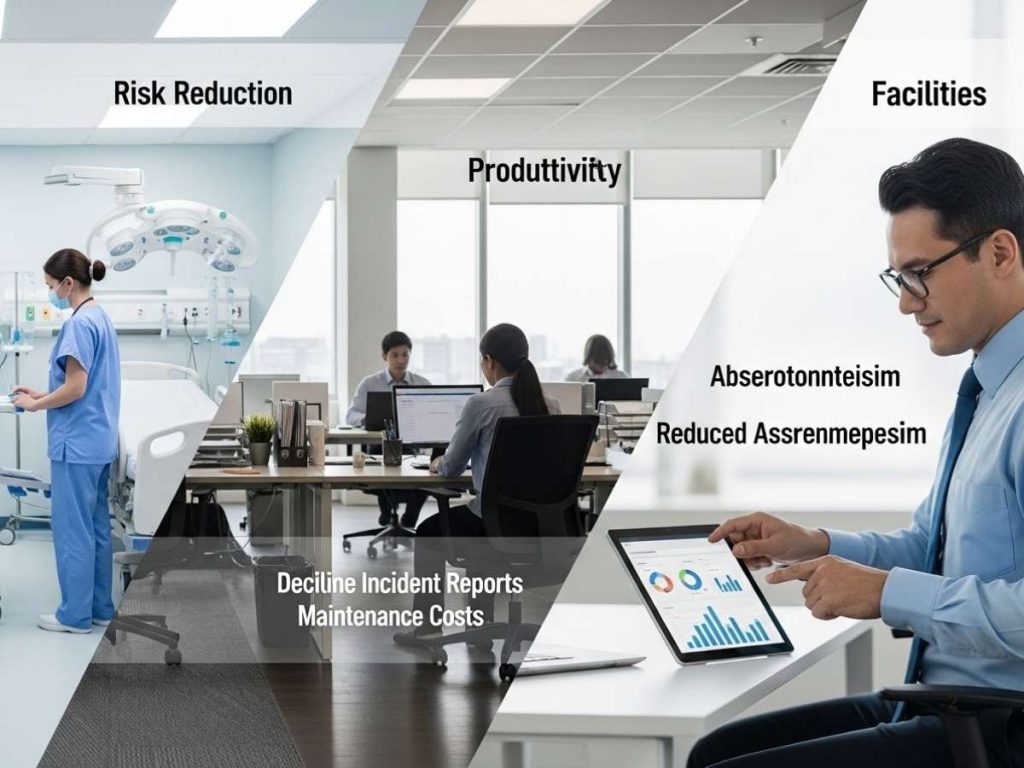
1. Risk Reduction and Compliance
Cleaning directly supports workplace safety and compliance standards.Fewer failed audits, reduced WHS risks, and stronger infection control processes lower the likelihood of incidents, insurance claims, or regulatory penalties.
Healthcare and medical environments, in particular, rely on structured sanitisation services to minimise contamination risk. Reduced exposure events mean fewer disruptions and lower liability.
Tracking incident reports related to hygiene, audit outcomes, and corrective action frequency gives a clear view of risk reduction value.
2. Absenteeism, Productivity, Assets, and Reputation
Cleaning quality directly affects workforce stability. Reviewing historical absenteeism data before and after service improvements highlights trends. A focus on hygiene standards contributes to reducing workplace absenteeism cleaning outcomes, particularly in shared workspaces and high-contact environments. We explore this further in how clean facilities reduce sick days.
Presentation also influences how teams perform. Structured environments reduce distractions and support focus. Research on workplace hygiene and productivity consistently link workplace hygiene to output. Additional insight is outlined in how clean workplaces improve employee productivity.
Asset longevity in commercial cleaning outcomes is often overlooked. Proper floor care, routine carpet maintenance, and surface protection extend replacement cycles. Delaying major capital expenditure has a measurable financial impact.
Complaint and satisfaction tracking also matters. Fewer tenant complaints and reduced service escalations indicate stability. This can directly influence retention in commercial property portfolios. First impressions shape trust and brand perception. Clean environments influence how clients, patients, and stakeholders assess an organisation’s standards. The operational effect of presentation is examined in how cleaning impacts business reputation.
Each of these categories links cleaning activity to measurable operational performance.
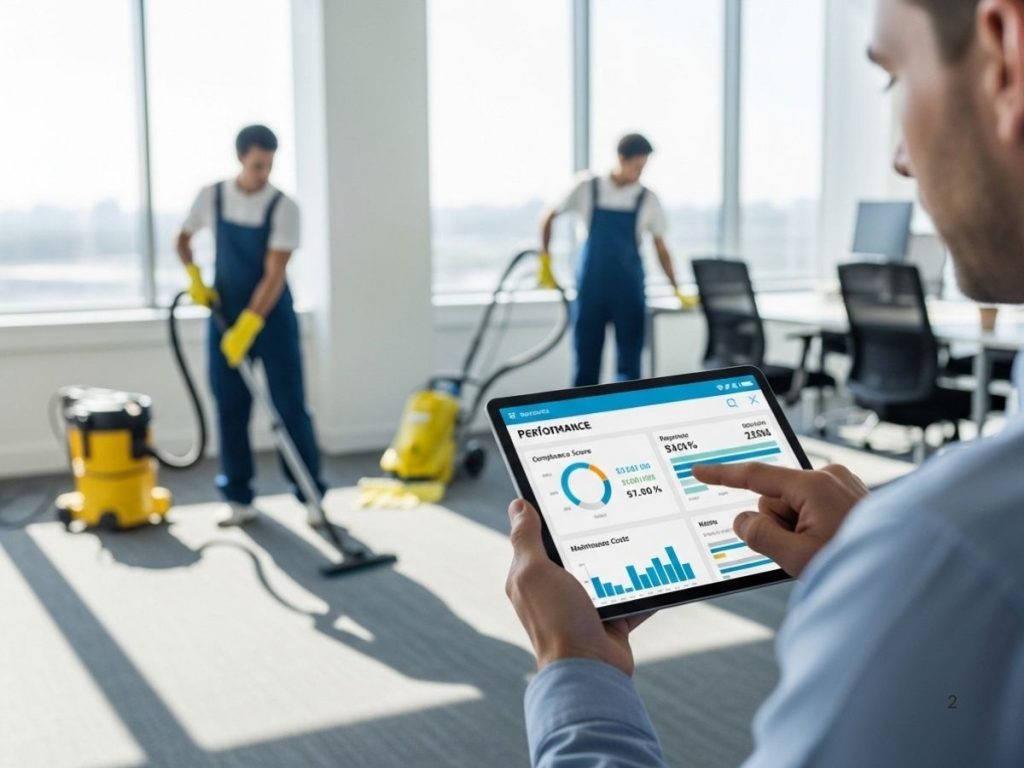
Facility Cleaning Metrics and KPIs That Translate to Financial Outcomes
Clear commercial cleaning KPIs must connect to operational impact. Task completion alone is insufficient. Vacuuming a floor has limited value if asset deterioration still accelerates.
Under a structured KPI framework, focus on measurable performance indicators such as:
- Compliance audit scores and reporting consistency
- Response times to service issues
- Complaint frequency per month or per site
- Sick leave percentage trends
- Maintenance expenditure for carpets, hard floors, and fixtures
These indicators translate directly to financial outcomes.
Core facility cleaning metrics to monitor include absenteeism rates before and after service adjustments, annual maintenance and replacement budgets, tenant retention rates within commercial property environments, and cleanliness-related incident reports.
Avoid vague statements like “improved productivity.” Instead, require measurable indicators such as reduced unplanned leave, lower reactive repairs, or fewer escalated issues.
A practical performance review should link cleaning activities to operational results. If cleaning frequency decreases, maintenance costs often rise. If hygiene standards improve, complaint frequency often falls. This cause-and-effect relationship forms the foundation of how to measure cleaning performance effectively.

A Practical Framework to Calculate the ROI of Commercial Cleaning
Calculating the ROI of commercial cleaning requires a structured approach.
Step 1: Establish Baseline Metrics
Document the current absenteeism rate. Record annual reactive maintenance spend. Quantify the number of complaints per quarter. Capture compliance audit outcomes. These figures form the reference point.
Step 2: Define Cleaning Service Evaluation KPIs
Ensure the service scope is clear and measurable. Confirm audit frequency and reporting transparency. Strong general commercial cleaning programs provide documented results, not informal updates.
Step 3: Quantify Impact Areas
Translate operational improvements into financial terms.
For example, consider a 100-person Brisbane office. If sick leave reduces by one day per employee annually, multiply 100 recovered days by the average daily wage. That figure represents productivity value recovered.
If structured floor care delays carpet replacement by two years, capital expenditure spreads over a longer period. Asset longevity commercial cleaning ROI improves because replacement costs occur later and less frequently.
Step 4: Compare Total Operational Value vs Contract Cost
Apply the formula:
ROI = (Total measurable financial benefit – Annual cleaning contract cost) ÷ Annual cleaning contract cost
Some returns remain qualitative, such as improved confidence from tenants or patients. Even so, these outcomes influence retention, referrals, and stakeholder trust. They carry strategic value even when harder to quantify.

Example Scenario: Measuring ROI in a Mid-Sized Office or Medical Facility
Consider a 7,500 sqm office or medical centre in Brisbane or the Gold Coast.
Baseline issues include frequent complaints, rising sick leave, and increasing floor repair costs. Annual payroll sits at $8 million. Reactive maintenance costs $200,000 per year. The absenteeism rate averages 5%.
After structured cleaning performance improvements and tighter KPI tracking:
- Complaints reduce by 15% over 12 months.
- Reactive maintenance spend declines by 5%.
- Absenteeism rate drops from 5% to 4%.
If 100 employees average $350 per day in labour cost and absenteeism reduces by 1%, the business recovers approximately 260 workdays annually (1% of 26,000 total workdays). That equals $91,000 in regained productivity value.
A 5% reduction in reactive maintenance on $200,000 saves $10,000 annually.
Fewer complaints reduce management time spent resolving issues. Even a modest reduction in escalations can free supervisory capacity for higher-value tasks.
If the annual cleaning contract is $180,000 and total measurable benefit exceeds $100,000, the net ROI becomes clear. The commercial cleaning return on investment is grounded in real operational metrics, without exaggerated assumptions.
For organisations reviewing budget allocations, understanding market benchmarks is also important. Cost context helps frame ROI discussions. Relevant pricing insights are outlined in how much commercial cleaners charge per hour.

Using ROI Data for Vendor Comparison and Contract Renewal Decisions
Cleaning service evaluation data should guide vendor comparison commercial cleaning processes. Tender price alone does not reflect service impact.
During a cleaning contract renewal evaluation, assess 12–24 months of KPI trend data. Review audit transparency. Examine issue resolution patterns and response times. Look for consistent reporting rather than reactive explanations.
Facilities operating under structured janitorial services programs benefit from documented accountability and defined service levels.
Before renewing or changing providers, conduct a structured review. A practical starting point is how to audit your current cleaning provider. Objective evaluation clarifies whether performance gaps exist or whether improvements will deliver measurable ROI gains.
Decision-makers should evaluate providers on total operational value. A lower tender may reduce invoice cost but increase operational instability.
Facilities teams should review their current facility cleaning metrics and identify measurable improvement areas. A structured assessment clarifies the current ROI of commercial cleaning and highlights realistic opportunities to improve performance and financial return. For organisations ready to benchmark service outcomes, request a service assessment and quantify improvement potential with clear metrics.
Frequently Asked Questions
How do you calculate the ROI of commercial cleaning services?
The ROI of commercial cleaning services is calculated by comparing measurable operational benefits to the annual contract cost. Use the formula: (Total financial benefit – Annual cleaning cost) ÷ Annual cleaning cost. Benefits may include reduced absenteeism, lower maintenance expenses, fewer complaints, and improved compliance scores. Converting these improvements into financial value helps businesses evaluate whether cleaning services deliver a positive return.
What metrics should be used to measure the ROI of commercial cleaning?
Key metrics include absenteeism rates, complaint frequency, compliance audit scores, response times to service issues, and reactive maintenance costs. These indicators reflect how cleaning quality affects operations. When tracked over time, improvements in these metrics can be translated into financial outcomes such as recovered workdays, lower repair costs, and reduced management time spent resolving hygiene-related issues.
Why is the ROI of commercial cleaning more than just cost savings?
The ROI of commercial cleaning extends beyond the contract price because cleaning influences productivity, workplace health, risk reduction, and asset longevity. Cleaner environments can reduce sick days, improve compliance outcomes, and extend the lifespan of carpets, floors, and fixtures. These operational benefits create financial value even though they may not appear directly on the cleaning invoice.
How long should businesses track data to evaluate cleaning service ROI?
Businesses should review at least 12–24 months of performance data to accurately measure the ROI of commercial cleaning services. A longer timeframe allows organizations to observe trends in absenteeism, maintenance spending, complaints, and compliance results. Evaluating data across multiple quarters provides a more reliable view of service impact than relying on short-term cost comparisons.
Can better cleaning services actually improve employee productivity?
Yes, improved workplace cleanliness can support higher employee productivity. Clean environments reduce distractions, improve hygiene conditions, and contribute to fewer illness-related absences. When employees take fewer sick days and work in organized spaces, businesses recover productive work hours. Over time, these recovered workdays become a measurable component of the ROI of commercial cleaning.disinfection and sanitisation services